
Hunger and Thirst
The origins of the word "tantalize"

tantalize
verb. to beckon, lure or tempt while remaining eternally out of reach.
Some people are remembered for their deeds, some for their misdeeds. There are a few, however, who are remembered chiefly for their fate. One such is the unfortunate Tantalus. Time and confusion have gnawed away the details of his life and crimes; all that remains is the awful spectacle of his damnation.
According to Greek myth, Tantalus was an ancient king. Sources disagree about the location of his supposed domain. He was variously said to reign over Sipylus near Smyrna, or else Paphlagonia in northern Asia Minor. Either way, he was a favorite son of Zeus, and held sway over a rich and bountiful kingdom.
Although Tantalus was mortal, he received an invitation to join the gods in a feast on Mount Olympus—a breach of protocol justified by Zeus on the grounds that Tantalus was an honorable and obedient son. At the banquet, however, Tantalus betrayed his father’s trust. One version holds that he tasted ambrosia, the magic brew that gave the gods their immortality, and attempted to smuggle a cup of it back to his kingdom. Another maintains that he overheard the gods discussing confidential plans for the affairs of mortals, and that he repeated this sensitive intelligence on earth.
These two offenses are sometimes compounded by a third, particularly vicious crime: Somehow imagining that he could hoodwink his divine hosts, Tantalus butchered his own infant son, Pelops, and served him in a stew. At the first taste of this depraved broth, the gods realized its main ingredient, and restored Pelops to life. (Unfortunately, Demeter, the goddess of fertility, had already eaten a shoulder-blade, but Hephaestus, god of blacksmiths, fashioned a substitute out of ivory.)
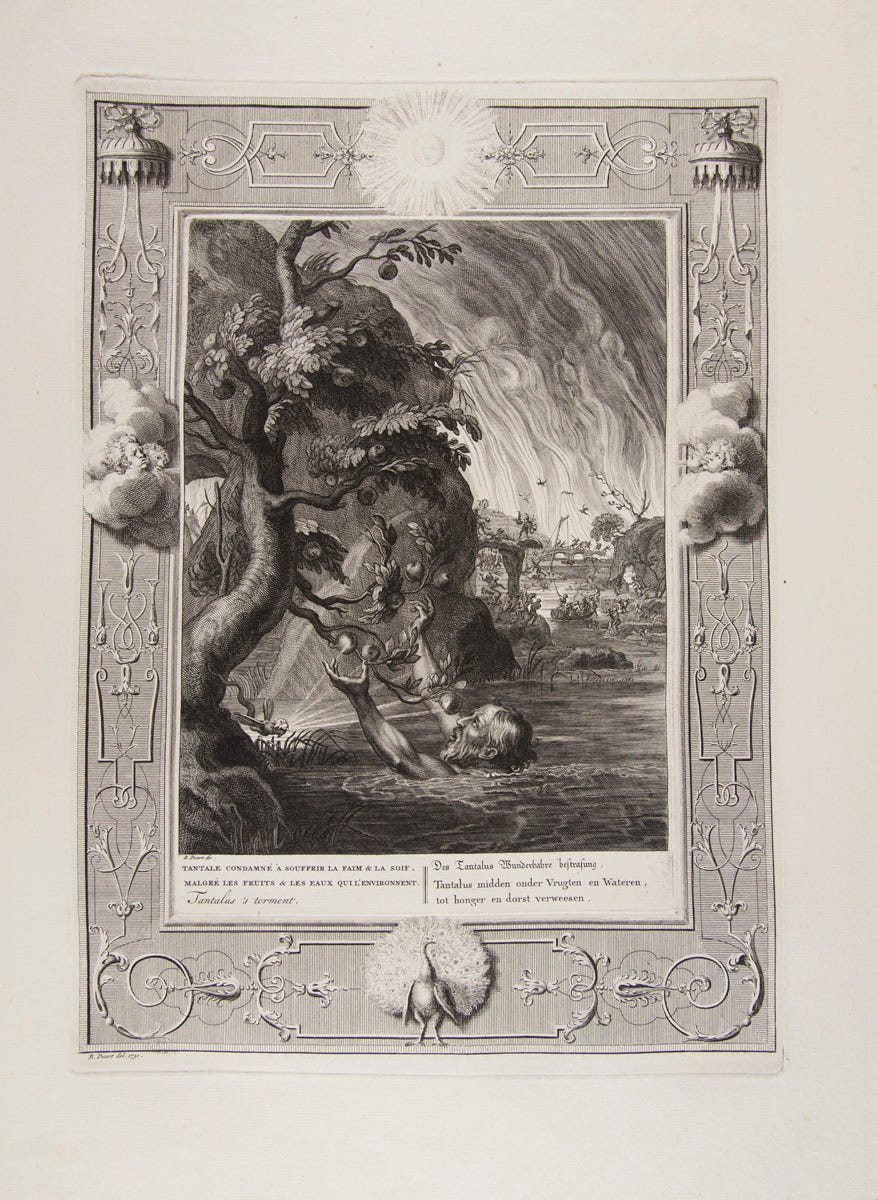
For these transgressions (whatever they were), Tantalus paid an awful price. He was banished to Tartarus, the gloomiest level of hell, and condemned to stand up to his neck in a pool of water, shaded by trees whose fruit—ripe pears, fragrant apples, luscious figs and juicy olives—dangle over his head. But every time he lunges for a piece of fruit, the wind lifts the branches out of his grasp. Every time he bends to slake his thirst, the water magically recedes. So he stands to this day, wracked by hunger and thirst, maddened by temptation that is eternally beyond his reach.
The earliest mention of Tantalus is found in Book XI of Homer’s Odyssey, in which Odysseus sails to the edge of the world and enters the realm of Hades. There he witnesses not only the punishment of Tantalus, but also the cruel fate of Sisyphus, forever doomed to roll a rock up a hill. and another of the select group of people whose eponyms From gives us the phrase Sisyphean task—another of the select group of people immortalized for their adventures beyond the grave.
Words inspired by Tantalus entered English literature in the late sixteenth century, according to the Oxford English Dictionary. The first was tantalize, which showed up in a poem from 1597 by Robert Tofte. Other early versions include tantalism (1614) and tantalean (1618).
Tantalus also gave his name to the metal tantalum, an element first identified by Swedish chemist Anders Ekeberg in 1802. Ekeberg dubbed his new discovery after Tantalus because it was incapable of absorbing acid even when immersed in a vat, and also in reference to the metal’s elusive nature. It was not purified in significant quantities for more than 100 years.
Sources: Carlos Parada, Greek Mythology; Michael Stapleton, Illustrated Dictionary of Greek and Roman Mythology. Oxford English Dictionary: tantalize. Wikipedia: Tantalum. Alexander Pope, The Odyssey.